
Your dog’s ideal weight: how to check it by hand and on the scales
You can’t read your dog’s ideal weight off a breed chart. You judge it with your hands on the ribs and your eyes on the waist, and the scales tell you which way things are heading.
This guide is general information and does not replace a vet’s assessment. If you are worried about your dog, call your vet.
Contents
Your dog’s ideal weight is the weight at which the ribs are easy to feel under a thin layer of fat and the waist shows. So body condition, which you can judge yourself by hand, matters more than the number of kilos. It’s worth checking regularly, because extra weight builds up slowly and the eye adjusts: VCA Animal Hospitals cites a 2022 survey in the United States in which 59% of dogs were overweight.
Why a dog weight chart isn’t enough
The weight range in a breed standard tells you what size dogs of that breed typically are. It doesn’t tell you what your own dog should weigh. Within one breed there are big-framed and slight individuals, males and females differ in size, and for a mixed breed there’s no chart at all. The same number of kilos can be right for one dog and several kilos too many for another of the same breed.
Dogs don’t have a formula like the human body mass index. Vets use the body condition score, which directly assesses how much fat the dog is carrying over its bones.
Body condition score 1–9: check your dog by hand
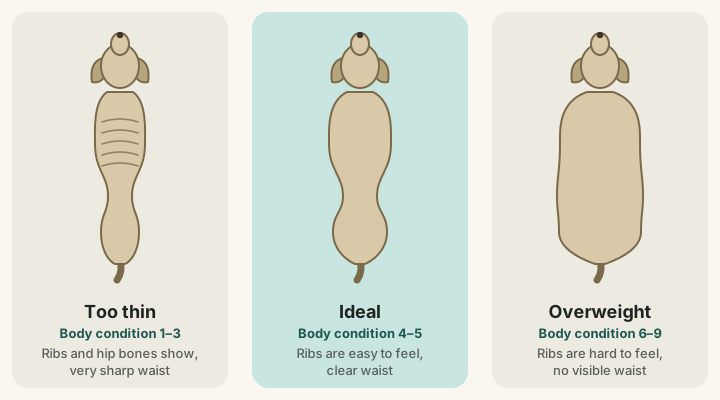
The body condition score, or BCS, is a nine-point scale. The descriptions below are from the World Small Animal Veterinary Association’s body condition score chart, on which 4–5 is ideal. You judge three things, and with a long-haired dog your hands tell you more than your eyes.
- Ribs. Place your palms on the dog’s sides and run your fingers lightly over the ribs. In a dog in good condition you can feel them easily without pressing, under a thin layer of fat.
- Waist. Look straight down at the dog while it’s standing. You should see a clear narrowing behind the ribs.
- Belly line. Look at the dog from the side. The underline of the belly should rise from the chest towards the back legs.
| Body condition | Ribs | Waist from above | Belly line from the side |
|---|---|---|---|
| 1–3, too thin | Visible, or felt with no fat cover | Very pronounced | Rises steeply |
| 4–5, ideal | Easy to feel, thin fat cover | Clearly visible | Clearly rises |
| 6–7, overweight | Felt through fat, with difficulty at 7 | Faint or absent | Slight |
| 8–9, obese | Can’t be felt, or only with firm pressure | Not visible | Doesn’t rise; belly may bulge |
At scores 7–9, fat also builds up over the lower back and the base of the tail, and at 9 on the neck and legs as well. At 1–2 the dog has lost muscle as well as fat.
WSAVA’s nutritional assessment guidelines point out that a dog in ideal condition can look too thin to its owner. If you’re wavering between 5 and 6, ask your vet or a vet nurse to assess the dog and show you what the right amount of cover feels like. Note down the body condition score when you weigh the dog, so you can see the change later.
How to weigh a dog at home and track its weight
Small or medium-sized dog. Weigh yourself on bathroom scales first, then weigh yourself holding the dog, and work out the difference. Bathroom scales are too coarse for a very small dog, where a change of 100 g already matters. You can weigh a small dog more accurately in its carrier on baby scales, for instance, or at the clinic.
Large dog. Veterinary clinics have walk-on floor scales for dogs. Ask your clinic whether you can bring the dog in to be weighed without an appointment.
Always use the same scales and weigh at the same time of day, for example in the morning before breakfast. Readings from different scales can differ by more than your dog’s weight really changes.
How often. There’s no research-based recommendation. As a rule of thumb, you can weigh a healthy adult dog once a month. WSAVA’s guidelines say growing and senior dogs need more frequent monitoring, and the same goes for a dog whose food or medication has just changed.
What to look for in the weight curve
A single reading swings according to whether the dog has just eaten, drunk or been to the toilet. So look at the direction across several weigh-ins.
- A slow rise. A worked example: 300 g a month doesn’t sound like much, but over a year it’s 3.6 kg. For a 20 kg dog that’s 18% more weight, which turns a dog at its ideal weight into a clearly overweight one.
- A fall for no reason. The weight is dropping even though food and exercise are unchanged. This is a reason to contact your vet.
- A shift after a change in the dog’s life. Neutering, a house move, a new food or less exercise can show up on the curve after a delay.
A curve drawn on paper does the same job. If you’d rather have the trend worked out for you, Koiru shows it from your weigh-ins.
The risks of being overweight
According to VCA Animal Hospitals, a dog is overweight when it weighs 10–20% more than its ideal weight and obese when it is more than 20% over. The same source lists the risks linked to excess weight as arthritis, diabetes, heart disease, high blood pressure, bladder stones, cancer and complications under anaesthesia. VCA says that being even moderately overweight can shorten a dog’s life expectancy by nearly two years.
According to WSAVA’s nutritional assessment guidelines, disease risks appear to increase once the body condition score goes above 6. So a score of 6 is a good moment to review the amount you feed, before more kilos pile on.
Helping a dog lose weight safely
Plan weight loss with your vet. They will estimate a target weight from the dog’s body condition, check that no illness lies behind the weight gain and work out the daily calories.
- Pace. VCA’s general guide is 0.5–2% of body weight a week, and your vet sets the exact goal. For a 25 kg dog the range is 125–500 g a week.
- The amount of food is calculated at the target weight, not the current weight. The principle is explained in our guide on how much to feed a dog.
- Don’t just halve the portion. When you cut an ordinary food sharply, protein, vitamins and minerals go down with it. Your vet can recommend a food that provides enough of them on fewer calories.
- Treats count. Everything the dog swallows apart from water contains calories. According to VCA, treats and other extras should make up no more than 10% of the day’s calories.
- Get the whole family on board. The plan only holds if everyone who feeds the dog knows the day’s amount.
- Weigh regularly. If you can’t weigh the dog at home, VCA suggests calling in to use the clinic’s scales every two weeks. Agree with your vet when the amount of food should change.
Unexplained weight loss is a reason to contact your vet. If your dog is losing weight even though its food and exercise haven’t changed, book an appointment. If the dog is also vomiting, has diarrhoea, is drinking more than usual or is listless, call your vet straight away.
Weight in puppies and senior dogs
Puppies. A puppy’s weight is supposed to go up, so kilos alone don’t tell you whether it’s in good condition. The same hands-on check works: the ribs shouldn’t show, but you should be able to feel them easily, and there should be a visible waist. Don’t put a puppy on a diet on your own. If your puppy is round or thin, or isn’t gaining weight, contact your vet.
Senior dogs. With an old dog the scales alone can mislead, because muscle can waste away while fat stays the same or increases. According to WSAVA’s guidelines, muscle condition is assessed by feeling over the temples, the shoulder blades, the spine in the lower back and the pelvic bones, and senior dogs need more frequent monitoring than other adults. An old dog that is losing weight should be examined by a vet even if it seems bright otherwise.
Written by the Koiru editorial team from the sources listed above. This text has not been reviewed by a vet. How we write our guides
Questions
Frequently asked questions
How do I know what my dog’s ideal weight is?
The ideal weight is the weight at which your dog’s body condition score is 4–5 on a scale of 1–9. At that point the ribs are easy to feel, the waist shows and the belly line rises towards the back legs. The weight range in a breed standard gives you a ballpark, but dogs of the same breed come in different sizes. Your vet can estimate the ideal weight in kilos at an appointment.
Is there a BMI or weight chart for dogs?
Dogs don’t have a formula like the human body mass index. Vets judge the amount of fat by hand and eye using the body condition score, or BCS, on a scale of 1–9. Breed standards list typical weights, but they describe the range for the breed, not whether your own dog is carrying too much fat.
How often should I weigh my dog?
There’s no research-based recommendation, but as a rule of thumb you can weigh a healthy adult dog once a month. WSAVA’s guidelines say growing and senior dogs need more frequent monitoring, and VCA suggests using the clinic’s scales every two weeks during weight loss if you can’t weigh the dog at home. If the weight changes noticeably without explanation, contact your vet; don’t wait for the next weigh-in.
How fast should a dog lose weight?
The general guide from the veterinary group VCA is 0.5–2% of body weight a week. For a 25 kg dog that means 125–500 g a week. The pace and the amount of food are for your vet to decide, though, and they will also check that no illness lies behind the weight gain. Don’t slim a dog down on your own by cutting its portion sharply.
Why isn’t my dog gaining weight even though it eats well?
The dog may be getting too few calories for the energy it uses, but illness is another possibility. If your dog eats normally and still doesn’t gain weight, or loses it, book a vet appointment. Take your weigh-in results with you, along with a note of what the dog eats and how much.
How can I tell if my dog is too thin?
At WSAVA body condition scores 1–3, the ribs, spine or pelvic bones are visible or can be felt with no fat over them, and the waist and belly tuck are very pronounced. A coat can hide thinness, so always feel with your hands. If your dog has lost weight for no clear reason, take it to the vet.
How it works in Koiru
The weight curve shows the trend your eye has got used to
In Koiru every weigh-in is saved to the dog’s weight curve. For each entry you can choose how the weight was taken (on scales, as an estimate or at the vet’s) and add a body condition score from 1 to 9. From the weigh-ins the app shows a trend: the weight is stable, rising or falling.
You can set a repeating reminder for weigh-ins, and when it’s marked as done you can see who in the family weighed the dog and when. For a vet visit you can get a Health report for the period you choose as a PDF. Besides weight, it includes meals, symptoms and medications.
- A weight curve and trend – stable, rising or falling
- Body condition (BCS) 1–9 recorded with the weigh-in
- A repeating weigh-in reminder for the whole family
- A Health report as a PDF for the vet


The 14-day free trial requires starting a subscription in the app store. After the trial Koiru costs €6.99 a month or €49.99 a year, and one subscription covers the whole family. You can cancel at any time before the trial ends. See what’s included
Weight
Last 6 months
- 24.6 kg Home scales · body condition 6/9
- Rising +1.1 kg in six months
- 24.3 kg Weighed at the vet’s
- Weigh-in every four weeks Next on 16 Dec
Illustration. The screen in the app may look different.